
source: wrytin.com
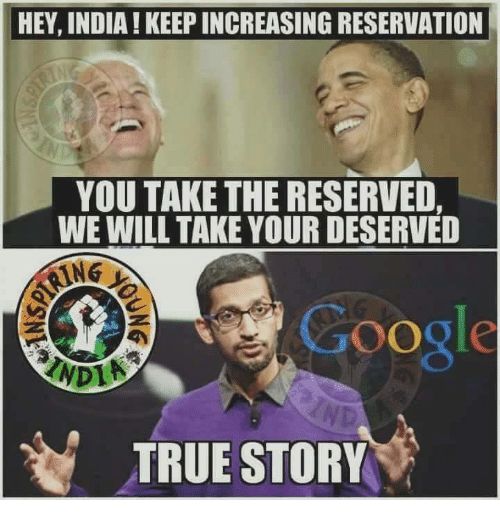
I recently came across a meme mocking India’s reservation system. It stated that India is taking the reserved, while America is taking the deserved. This doesn’t need to be explained but shows how this system needs to be changed.
The Women Reservation Bill, 2023 was recently enacted and signed by the president, becoming law. In the Lok Sabha, state legislatures, and the Legislative Assembly of the National Capital Territory of Delhi, the Bill reserves one-third of all seats for women. The Bill would be effective once the census has been conducted and published and the delimitation exercise has been carried out. In 2001, the delimitation exercise was frozen till 2026, showing no hope of implementing the law shortly. And this is where the primary issue occurs, which took a political turn and provided a platform for the emergence of parties (which is necessary in a democracy, nevertheless).
Reservations are currently a prevalent practice in India. Soon after independence, it began. It is frequently argued that it is one of the most essential tools for uplifting the nation’s poor and backward communities. Even the method has received praise throughout the world. However, there are times when reservation seems more like a political weapon than a tool for empowering people. Politicians portray the reservation as a wealthy platform to win over the entire voter base. No group’s reservation has produced the anticipated results. Nothing about reservations—for women or for any other group—has been as beneficial to the public as claimed in election manifestos or in speeches by candidates. Social awareness, education, eradicating ignorance, and preaching the message of strength to the group are all ways to empower people.
Following its first introduction, the reservation clause was linked to vote-bank politics and regularly expanded by successful administrations and the Indian Parliament without any open and equitable reforms. The current reservation system could undermine the country’s economic structure by aiming to lower labor productivity. Our family will gradually get judges, doctors, and instructors who are less competent. The reservation system merely deepens social divisions, fueling prejudice and hostility between various groups. It is repressive even when caste is not involved. It is the very antithesis of community living.
A toll on unreserved category students:
Caste-based discrimination is unfair to deserving students from other categories since it keeps them from attending the colleges of their choice. For instance, the final seat in Uttarakhand earned by a student from an unreserved category required almost 529 marks, while the same heart roughly needed 338 signatures for a student from a reserved category, according to the NEET 2019 counselling results for Uttarakhand. The unreserved meritorious students have suffered because of the massive disparity in numbers. Opportunities for pupils must be based on their skills and socioeconomic situations rather than caste-based advantages. Raising skill-based institutions or courses may be possible so everyone is on the same playing field. Reservations in public services led to resentment and disagreement among government employees, degrading the work atmosphere. Domicile reservations have also proven successful in deterring such pupils. And why do we refer to India as Bharat, a union of states, if the government only wants to promote its own citizens to study in their own states or hold any governmental position?
Radical alternatives include eliminating the entire creamy layer among all castes from the reservation and enhancing their talents rather than throwing out reservations for entry to higher education or employment on a silver platter. Although reservations play a significant role in several sectors, not all situations necessitate their use. These days, it has developed into yet another corrupting tool, supported legally by the government and purported political parties. It is little more than a legal backdoor in several areas, including employment and education, where the only real winners are the political parties.
 Rushil Gupta- Thinking Beyond Imagination
Leave a comment